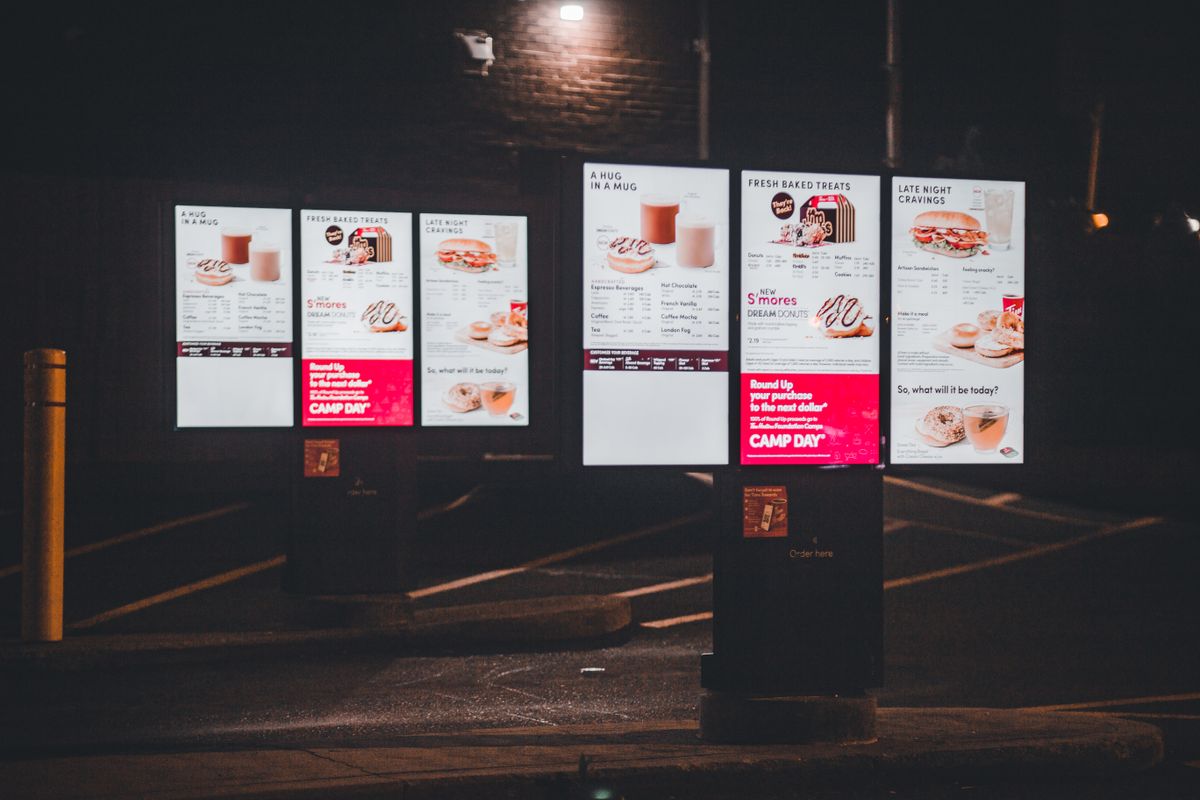
Retail Digital Signage: An Executive's Tech Playbook
Build retail digital signage that scales. See how executives choose a platform, wire in live data, and prove store-level ROI across every location.
Most retail executives inherited their in-store screens rather than chose them. A regional VP approved a few displays for a flagship. Marketing bought a window screen for a holiday campaign. Someone in ops put a TV in the break room. Five years later you have a few hundred displays, four vendors, no inventory list, and no idea how many are actually on right now.
That is not a signage problem. That is an unmanaged endpoint fleet sitting in your highest-value real estate.
If you sit in the C-suite of a retail organization and you are the person who tends to see technology shifts early, retail digital signage is worth a second look — not because screens are new, but because the platform layer underneath them finally caught up to what you would expect from any other piece of enterprise software. This is the executive view: what the category actually does now, what to demand from a vendor, and how to sequence a rollout that survives a board review.
Why Retail Digital Signage Is an Infrastructure Decision, Not a Marketing Buy
The old framing treated in-store displays as a campaign expense. You budgeted for a seasonal creative push, the screens showed it, and the line item closed at the end of the quarter. Under that model nobody owned the network, so nobody maintained it.
The current framing is different. A managed display network is a distribution channel you own outright — no platform fees, no algorithm, no bidding against your own competitors for attention you already paid rent to reach. Every store you operate is a media property with guaranteed foot traffic, and the screens are how you address it.
That reframe changes who should own the decision. A channel with fixed inventory, measurable reach, and a technical dependency belongs to the same executive conversation as your POS, your inventory system, and your customer data platform. It is not a decor question.
The Three Numbers That Make the Case Internally
- Time to update every store. If a price or promotion change takes days because it routes through print, you are measuring your own reaction speed. Cloud-managed screens make it minutes.
- Annual print and installation spend. Signage kits, shipping, and the labor to hang them in each store. Most retail organizations underestimate this by a wide margin because it is scattered across store-level budgets.
- Percentage of displays online right now. If you cannot answer this from a dashboard, you do not have a network. You have furniture.
The Four Jobs Screens Actually Do in a Modern Store
Before evaluating platforms, get specific about what you are buying. In retail, the return concentrates in four applications.
1. Promotional and Pricing Consistency
The most defensible use case is also the least glamorous. When a promotion launches, it should launch everywhere at the same moment, with the same terms, at the same price. Manual processes guarantee drift — one store runs last month's offer, another never received the kit. Digital displays make the campaign atomic: publish once, live everywhere, verifiable from a dashboard.
2. Category Education and Product Discovery
Screens do their best work where the product is complex enough that shoppers hesitate. Endcap displays that explain a product line, comparison content at the shelf, and how-to video near high-consideration categories all lift conversion on items that benefit from explanation. This is why signage often performs better in specialty retail than in commodity aisles.
3. Queue and Service-Counter Experience
Wait time perception drops measurably when there is something worth looking at, and queue-line screens are prime real estate for attachment items. In service-counter formats — pickup desks, parts counters, order-ahead windows — order-status boards reduce the interruption load on staff, which is a labor argument as much as an experience one.
4. Employee Communication in the Back of House
The screen executives forget to budget for and later defend the hardest. Store associates are largely deskless and rarely read corporate email. A back-room display showing today's targets, safety reminders, schedule changes, and recognition reaches every shift without another all-staff message nobody opens.
What to Demand From a Retail Digital Signage Platform
Hardware gets replaced on a five-to-seven-year cycle. The platform is what your teams live in every day, and it determines whether the network is still being used in year three. Evaluate in this order.
A Cloud CMS With Real Integrations
Content management should live in a browser, not on a machine in a specific building. More importantly for a tech-forward buyer: ask what the platform can pull in automatically. Live data feeds, web content, social streams, weather, and scheduled dayparting all remove humans from the update loop. Anything a person has to retype weekly will eventually go stale, and stale content is what kills these programs.
Location Groups and Role-Based Permissions
This is the single feature that separates platforms built for chains from platforms built for one storefront. You need corporate to publish network-wide content that store teams cannot override, while store or regional managers retain a defined zone for local hours, local events, and local hiring notices. Grouping by region, by format, by banner, or by screen type should be native — not a workaround involving separate accounts.
A Template Library That Removes the Design Bottleneck
Every stalled signage program traces back to the same failure: content updates required a designer, so updates stopped. truDigital ships more than 500 templates and apps precisely so a regional marketing coordinator can produce an on-brand promotional layout in minutes without opening design software. Consistency comes from a locked template set, not from policing the people using it. You can browse the integration and app library to see what connects out of the box.
Fleet Visibility and Uptime Monitoring
Ask for a live screenshot of the health dashboard during the demo. You should see every player, its last check-in, and what it is currently displaying. Silent failure is the expensive failure mode in retail — a dark screen in a flagship store during a campaign launch costs more than the hardware, and if you are relying on store managers to report it, you will not hear about it for weeks.
Support That Reaches a Human
Store technology fails in front of customers, and the person standing next to the dead screen is an hourly associate, not an IT engineer. Ask directly whether support is metered, whether it is included, and where it is based. truDigital includes unlimited US-based support on every plan, which matters more than a small difference in monthly rate the first time a display goes dark on a Saturday.
The Retail Media Opportunity Sitting in Your Stores
Here is the part that turns a cost center into a P&L line. If you carry vendor brands, those vendors are already buying attention — on marketplaces, on social, in circulars. Your in-store screens are inventory you can sell them, with a measurable audience standing in front of the product.
The operational requirements are real but not exotic: consistent slot formats, proof-of-play reporting so you can invoice against delivered impressions, and enough network reliability that you can sell against it without embarrassment. Retailers who get this right frequently cover the entire cost of the signage program through co-op and vendor-funded slots, then keep the margin.
Do not lead with this in phase one. Build the network, prove uptime, then open the conversation with your three largest vendor partners once you can show them a reliable audience.
A Rollout Sequence That Survives a Board Review
The failure mode for tech-forward executives is deploying everywhere at once because the technology is interesting. Staged rollouts produce evidence, and evidence is what funds phase two.
- Phase one — a ten to twenty store pilot. Pick a representative mix of formats and volumes, not just your best stores. Install the two highest-value placements per store and nothing else. Name one owner at corporate and one per region.
- Phase two — instrument it. Baseline the categories the screens promote, then run a matched comparison against non-pilot stores. Sixty days is usually enough to see whether placement and content are working.
- Phase three — standardize the playbook. Document screen placement, hardware spec, network requirements, template set, and launch checklist. Once this exists, adding a store is a shipping task rather than a project.
- Phase four — scale and monetize. Roll the playbook chain-wide and open the vendor-funded conversation with proof-of-play data in hand.
truDigital works with multi-site operators running exactly this pattern across retail and adjacent formats — Queen City Winnelson in plumbing supply showrooms, Totten Tubes across its Azusa and Cedar City locations, and Storage Authority at its customer-facing sites. The common thread is not store count. It is that one person can change what every location displays without leaving their desk.
The Metrics That Belong in Your Quarterly Deck
Decide what you are measuring before the first display ships, or you will be arguing from anecdote at renewal. Five numbers are enough:
- Network uptime. Percentage of displays online, reported weekly. Target 98% or better and hold the vendor to it.
- Time-to-publish. Hours from campaign approval to live in every store. This is the number that most clearly demonstrates the operational gain.
- Promoted category lift. Units and margin on screen-promoted items in pilot stores versus a matched control group.
- Print and installation spend eliminated. Straightforward, defensible, and usually larger than expected.
- Content freshness. Percentage of screens updated in the last 14 days. This leading indicator predicts every other number on the list.
If freshness is high and lift is flat, your content is the problem, not the platform — and content is the cheapest variable to change.
Where to Start
Retail digital signage stopped being a creative purchase and became an operating system for your physical footprint. The organizations getting real return from it are not the ones with the most displays. They are the ones who can answer three questions instantly: how many screens are online, how fast can we change all of them, and what did the last campaign do to units in the stores that ran it.
If you cannot answer those today, that is the gap worth closing. See how other chains structure their networks on our retail digital signage page, and read the hidden costs of cheap digital signage before you compare quotes — the consumer-hardware shortcut is the most expensive path at scale.
Ready to see it running? Request a free truDigital demo and we will walk through a pilot plan sized to your store count, your formats, and the metrics your board cares about.
See it in Action
Get a free, no-pressure demo of our unique platform and find out how it can transform your business.